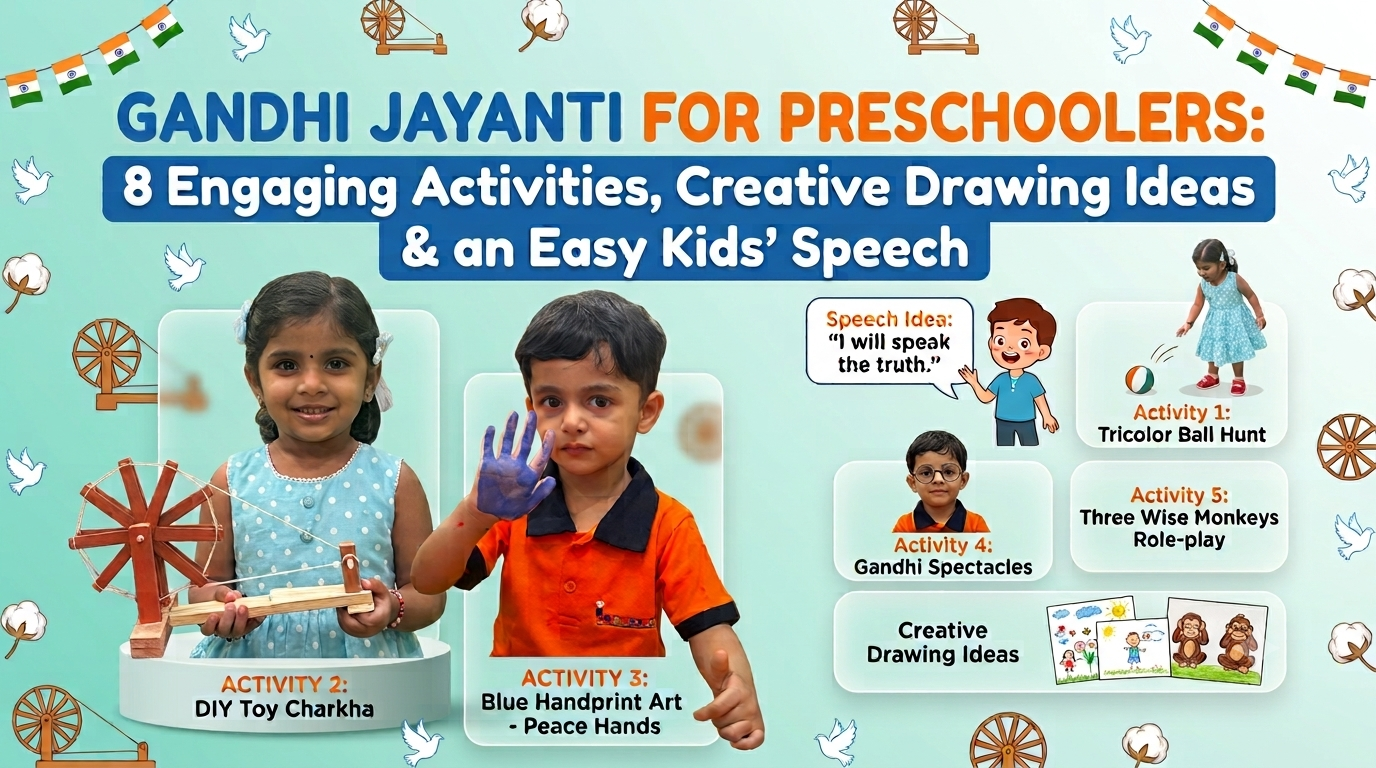
Gandhi
Jayanti for Preschoolers: 8 Engaging Activities, Creative Drawing Ideas &
an Easy Kids’ Speech
Gandhi Jayanti is observed every year on 2 October to remember Mahatma Gandhi
and the values associated with his life, including truth, peace, simplicity and
non-violence. For preschool children, these ideas do not need to be taught
through long lessons or complicated historical details. Young children learn
naturally through stories, art,
movement, conversation and hands-on activities.
A preschool classroom can turn Gandhi Jayanti into a simple
and meaningful learning experience. Children can draw, make crafts, listen to a
short story, practice kind behavior and take part in a small cleanliness
activity. These experiences can help children understand important values in a
way that feels enjoyable and age-appropriate.
At ImpressionsSchools, activity-based and play-based learning gives children
opportunities to explore concepts through participation and creativity. For
young learners, celebrations such as Gandhi Jayanti can become another
opportunity to learn while having fun.
Here are 8 engaging
Gandhi Jayanti activities for preschoolers that teachers and parents can
easily introduce.
1. Make a
Simple Gandhi Ji Drawing
Drawing is one of the easiest ways to introduce Gandhi Ji to
preschool children. Give every child a sheet of paper, pencil and crayons and
encourage them to create a simple picture of Mahatma Gandhi.
Teachers do not need to expect a perfect portrait. Instead,
children can focus on basic features such as:
• Round glasses
• A simple smiling face
• White clothing
• A walking stick
• A bald head
After completing the drawing, children can colour it using
crayons or colour pencils.
Learning benefit:
This activity supports creativity, hand-eye coordination, pencil control and
visual expression.
Easy
Drawing Idea
Teachers can first draw simple shapes on the board and allow
children to copy them step by step. Younger children can also use a ready-made
outline and colour it according to their own imagination.
2. Create a
“Peace and Kindness” Handprint Craft
Preschoolers enjoy activities where they can use their hands
and create something colourful. For a Gandhi Jayanti celebration, teachers can
introduce a simple peace and kindness
handprint craft.
Children can make a handprint on paper using child-safe
colours. Once the print dries, the teacher can help them write simple words
such as:
Peace • Kindness •
Truth • Love • Sharing
The handprint can then be displayed on a classroom wall.
This activity gives children a simple message: our hands can
be used to help, share and care for
others.
Learning benefit:
Children practice fine motor skills while discussing positive behavior.
3. Tell a
Short Story About Gandhi Ji
Storytelling can make historical personalities easier for
preschoolers to understand. Instead of explaining Gandhi Ji's entire life,
teachers can tell a short, age-appropriate story focused on values such as
honesty, kindness and peaceful behavior.
After the story, ask simple questions:
• What did Gandhi Ji believe in?
• Why should we tell the truth?
• How can we be kind to our friends?
• How can we solve problems peacefully?
Encourage children to answer in their own words. There is no
need to expect long or perfect answers.
Tip: Keep the
story short and use pictures, gestures and expressions to maintain children's
attention.
4. Dress-Up
Activity as Gandhi Ji
A simple dress-up activity can make Gandhi Jayanti memorable
for children. Teachers or parents can help children dress in a simple white
outfit and use safe, child-friendly props such as round paper glasses.
The purpose should not be to create a perfect costume.
Instead, children can briefly introduce themselves and say one or two simple
lines about Gandhi Ji.
For example:
“My name is Aarav.
Today I am dressed as Gandhi Ji. He taught us to speak the truth and live
peacefully.”
This activity encourages children to participate in front of
their classmates and gradually build confidence.
Learning benefit:
Dress-up and role-play support communication, imagination and social
development.
5. Three
Wise Monkeys Craft
The three wise
monkeys are a familiar visual representation often associated with Gandhi
Ji's teachings. Preschool teachers can use this concept for a simple craft and
discussion.
Children can make three monkey faces using paper plates,
coloured paper or drawing sheets. Each monkey can represent a simple positive
message:
• See no evil
• Hear no evil
• Speak no evil
For preschoolers, teachers can explain the idea in simple
language: we should try to see, hear and
say things that are kind and respectful.
The activity can be completed as a group project and
displayed in the classroom.
6.
Cleanliness Activity: “My Clean Classroom”
Gandhi Ji is widely associated with cleanliness and simple
living, making a small classroom cleanliness activity a practical way to
connect the celebration with everyday behavior.
Teachers can divide children into small groups and give them
age-appropriate tasks such as:
• Putting toys back in their place
• Arranging books
• Keeping craft materials organized
• Using the dustbin properly
• Keeping their activity table clean
While children participate, teachers can explain that
keeping our surroundings clean is everyone's responsibility.
Important:
Activities should always be supervised by adults and should use safe, age-appropriate
materials.
This simple activity can help children connect Gandhi
Jayanti with a habit they can practice every day.
7. Gandhi
Jayanti Drawing and Colouring Competition
A small drawing and colouring session can be organised for
preschool children. Give children a simple theme such as “Peace”, “Clean India”, “Kindness”, or “Gandhi Ji”.
Allow children to express their ideas freely instead of
expecting identical drawings.
For younger children, teachers can provide outlines. Older
preschoolers can draw their own pictures.
The focus should be on participation,
creativity and learning, rather than selecting only one winner.
Teachers can display the children's artwork on a classroom
board with a heading such as:
“Our Little Hands for
Peace and Kindness.”
8. A Simple
Gandhi Jayanti Speech for Preschoolers
A short speech gives children an opportunity to practice
speaking in front of others. Since preschoolers are still developing their
vocabulary and confidence, the speech should contain only a few easy sentences.
Easy Gandhi
Jayanti Speech
“Good morning
everyone.
My name is ________.
Today we are celebrating Gandhi Jayanti.
Gandhi Ji taught us to speak the truth and live peacefully.
He believed in kindness and non-violence.
We should keep our surroundings clean and help others.
Thank you and Happy Gandhi Jayanti!”
Teachers can help children practise the speech one line at a
time. Children who are not comfortable speaking alone can participate in a
small group.
Why Gandhi
Jayanti Activities Are Useful for Preschoolers
Festivals and special days can provide meaningful
opportunities for children to learn beyond regular classroom routines. A
well-planned Gandhi Jayanti activity can combine language development, creativity, social skills, motor development and
value-based learning.
Drawing helps children express ideas visually. Storytelling
develops listening and communication skills. Role-play encourages confidence,
while group activities teach children how to participate and cooperate with
others.
For more information about age-appropriate early learning,
parents can explore the PreschoolProgram offered by Impressions Schools. The program focuses on engaging
activities and learning experiences designed for young children.
How
Teachers Can Make the Celebration More Meaningful
The best Gandhi Jayanti activities for preschoolers do not
need to be expensive or complicated. A few sheets of paper, crayons,
storytelling and a little creativity can create a memorable classroom
experience.
Teachers can follow three simple principles:
Keep it simple:
Use short instructions and activities that children can understand easily.
Make it interactive:
Allow children to draw, speak, move, create and participate instead of only
listening.
Connect the lesson to
everyday life: Encourage children to practice simple values such as telling
the truth, sharing, helping friends and keeping their classroom clean.
Parents can also continue these conversations at home.
Simple activities such as drawing a peace poster, helping organize toys or
talking about kindness can reinforce what children learned at school.
Conclusion
Gandhi Jayanti can be much more than a special-day
celebration in a preschool classroom. With the right activities, children can
learn simple lessons about truth,
kindness, peace, cooperation and cleanliness while developing creativity
and confidence.
From a Gandhi Ji drawing and three wise monkeys craft to
storytelling, dress-up, cleanliness activities and a short speech, these ideas
can be adapted according to the children's age and interests.
At Impressions Schools, young children can be encouraged to
learn through engaging, age-appropriate experiences. Parents looking for a
supportive early learning environment can explore the Preschool Program and learn more about the school's approach to
early childhood education.