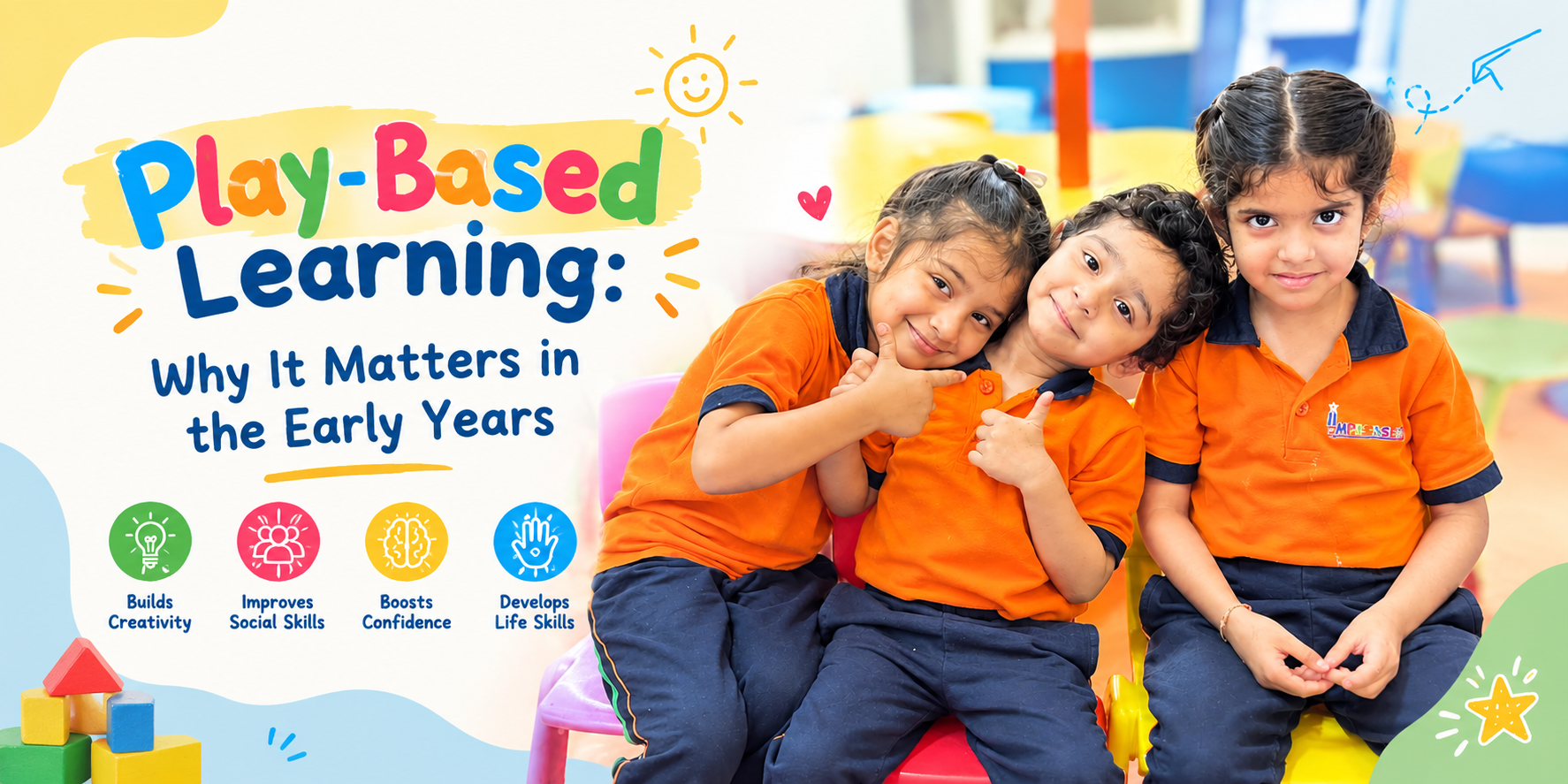
Introduction
For young children, learning does not always happen at a
desk with books and worksheets. Play is one of the most natural ways children
explore, understand and interact with the world around them.
When children build with blocks, participate in pretend
play, create artwork, listen to stories or play games with friends, they are
developing skills while having fun. This approach is known as play-based
learning.
For preschool children, the goal is not simply to keep them
busy. It is to create meaningful experiences where play and learning happen
together.
What Is Play-Based Learning?
Play-based learning is an approach where children learn
concepts and develop skills through purposeful play, exploration and hands-on
activities.
Educators create opportunities for children to:
·
Explore new materials
·
Ask questions
·
Make choices
·
Solve simple problems
·
Communicate with others
·
Experiment and discover
·
Express their ideas
·
Learn through hands-on experiences
Why Is Play-Based Learning Important for Preschoolers?
1. Builds Creativity and Imagination
Children naturally use their imagination during play.
Blocks, art, clay, storytelling and role play give children opportunities to
express their ideas creatively.
2. Develops Social Skills
Group games and collaborative activities encourage children
to share, take turns, listen, communicate and work together.
3. Helps Build Confidence
Completing a puzzle, building with blocks or finishing an
art project gives children opportunities to experience accomplishment,
independence and persistence.
4. Supports Problem-Solving Skills
Play often presents children with small challenges. Children
can think, experiment and try different approaches instead of simply receiving
an answer.
5. Strengthens Language and Communication
Storytelling, pretend play, songs and group conversations
provide opportunities for children to hear and use new words and communicate
their ideas.
6. Supports Physical Development
Running, jumping, climbing, dancing, throwing and catching
support movement and coordination. Drawing, puzzles, clay, threading and blocks
support fine-motor practice.
Types of Play-Based Learning Activities
Creative Play: Painting,
drawing, colouring, craft and clay activities.
Problem-Solving Play:
Puzzles, matching games, sorting activities and building blocks.
Pretend & Role
Play: Dramatic play, storytelling and imaginary situations.
Music & Movement:
Songs, dance, rhythm games and movement activities.
Outdoor Play: Nature
walks, gardening, running games and outdoor exploration.
Sensory Play: Age-appropriate
activities involving textures, shapes, sounds, water, sand or other sensory
materials.
Play-Based Learning at Preschool
A thoughtfully designed preschool does not have to choose
between learning and play. The two can work together.
Teachers can introduce learning concepts through stories,
games, activities, conversations and hands-on experiences.
|
Learning Area |
Play-Based Activity |
|
Numbers |
Counting blocks or objects |
|
Language |
Storytelling and picture conversations |
|
Shapes |
Shape puzzles and sorting |
|
Creativity |
Art and craft |
|
Social Skills |
Group games |
|
Motor Skills |
Clay, threading and movement |
|
General Awareness |
Nature exploration |
How Parents Can Encourage Learning Through Play at Home
Parents do not need expensive educational toys to support
play-based learning. Simple everyday activities can become learning
opportunities.
Build with blocks: Ask
your child to create a house, bridge or tower.
Read a story
together: Ask, “What do you think will happen next?”
Sort household
objects: Sort objects by colour, size or shape.
Create an art corner:
Provide paper, crayons and age-appropriate craft materials.
Play pretend games: Set
up a pretend shop, kitchen, clinic or classroom.
Explore nature: Look
at leaves, flowers, insects and different textures during an outdoor walk.
The objective is not to turn every activity into a lesson.
Give children time to explore, ask questions and enjoy the process.
Play-Based Learning and School Readiness
Play-based learning can support several abilities that
children use when they transition to formal schooling.
·
Listening
·
Following simple instructions
·
Communicating
·
Taking turns
·
Working with others
·
Concentrating on activities
·
Solving simple problems
·
Becoming more independent
The Role of Teachers in Play-Based Learning
·
Plan age-appropriate activities
·
Introduce new concepts
·
Ask open-ended questions
·
Encourage children to explore
·
Observe children's interests
·
Support communication
·
Provide appropriate guidance
·
Allow children to make choices
Teachers can create a balance between child-led exploration
and purposeful learning.
Why Parents Should Look for Play-Based Learning in a Preschool
When choosing a preschool, parents can look beyond
worksheets and classroom furniture. Consider asking:
·
Does the preschool provide hands-on activities?
·
Are children given opportunities for creative
expression?
·
Are there group and collaborative activities?
·
Is outdoor play included?
·
Are storytelling and music part of the routine?
·
Are activities appropriate for the child's age?
·
How do teachers encourage children to explore
and ask questions?
·
Is there a balance between structured activities
and free play?
Conclusion
Play is much more than fun—it can be a meaningful part of
early childhood learning.
Through carefully planned play experiences, children can
explore their surroundings, express themselves, communicate with others, solve
problems and develop confidence.
A strong early-learning environment gives children the
freedom to play, explore, discover and learn at their own pace, while teachers
provide the guidance and support they need.
At Impressions Schools, play-based and activity-based experiences can be integrated into the preschool journey to make early learning engaging, interactive and meaningful.
For more information, Visit us at: https://impressionsschools.com/